
|
|
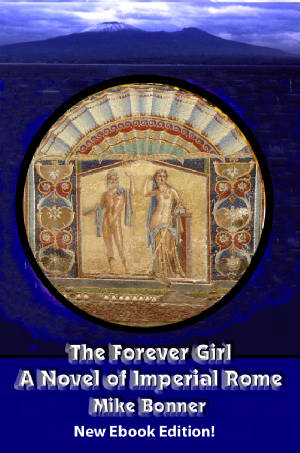
| Girl Book Cover |
|
| 2019 Edition |
YOUR BEST SUMMER READ!
The Forever Girl
A Novel of Imperial Rome
By Mike Bonner
When the volcano Vesuvius erupted nineteen centuries ago, it buried the Italian towns of Pompeii and Herculaneum
under as much as sixty feet of steaming debris. The popular imagination has long been fascinated by this dramatic event, depicted
in books from Edward Bulwer Lytton’s classic The Last Days of Pompeii to the more recent Pompeii, by Robert Harris.
But never has there been a more unsparing or authentic novel of the destruction of the ancient cities than
The Forever Girl.
The story begins in the winter of the year 72 C. E., when a young girl is taken into captivity after her Rhine
River village is overrun by Roman legionaries and their allies.
Her name is Kara.
Within the space of a few months, she goes from cherished daughter of loving parents to an orphaned and exploited
Roman slave. At the age of eight, she is cast adrift in a culture that has little regard for human life, especially slave
life.
Before being sold from the slave pens in the shadow of the unfinished Colosseum in Rome, Kara and the other survivors
of her tribe are displayed in a triumphal procession for the victorious general, Petilius Cerialis.
One asset, Kara's mane of beautiful golden hair, keeps her alive because of its value in producing the blond
wigs favored by fashionable Roman women. She is purchased by Agrippina, the wife of Senator Titus Clodius Eprius Marcellus
for precisely this purpose.
The Marcellus family divides its time between Rome and the magnificent estate it maintains near Herculaneum,
known as the "House of Books," for the vast library of papyrus scrolls it boasts.
Along with the story of Kara, the novel follows the life of a Roman soldier who participated in the destruction
of her tribe. This is Maximus Publius, a weary legionary whose existence is a rough and tumble of warfare against endless
barbarian enemies.
Besides these two principals, a varied cast of characters populates the novel, from the emperor Vespasian to
Tlarous, a gemcutter's son, who is dying from muscular dystrophy. From her friend Cletus, Kara learns of the new Christian
faith, promising a path to salvation.
Another key character is Anicius, a slave who murders his master when he is denied the freedom that was promised
him, setting off a chain of tragedies.
There is the gifted young writer Tacitus, who struggles to make a difference, in the literature and politics
of his age. On the bay of Neapolis, the tormented former slave Aurelius tries to come to terms with a shameful past. In the
forum of Herculaneum, the drunken fortune teller Paccia is a familiar figure, as is the ambitious magistrate, Lepidus Salvus.
There are bakers, musicians, vendors, tradesmen, laborers, and ordinary citizens. At the summit of Roman society
is the visionary Senator Marcellus, his privileged wife Agrippina, and their spoiled daughter, Amelia.
Towering over all is immortal Vesuvius, serenely unconcerned with the frantic, haunted lives of the human beings
at her base.
For many Romans, life is not only difficult, it is also viciously cruel and squalid. Down the backstreets dwells
Antonia, the brothelkeeper, who keeps a secret known only to herself and the man she loves. Meanwhile, being sold to Antonia
is the fear of every pretty slave girl, including Kara.
As she grows older, Kara is charged with attending her wealthy Roman family's prized grandson and heir, Justus.
Because she loves the babe, Kara is happy and filled with pleasure in performing this duty. This wins her the love of Marcus,
the child's father, but also the hatred of Agrippina, who schemes to consign Kara to the brothel.
On the day the fateful eruption occurs, it is the infant Justus that Kara risks her life to protect.
|
|
|